Texas Instruments TI-99/4 (1979-1981)
Texas Instruments TI-99/4 (1979-1981)
Texas Instruments
✅ TI-99/4
🥇First Commercially-Released 16-Bit Home Computer
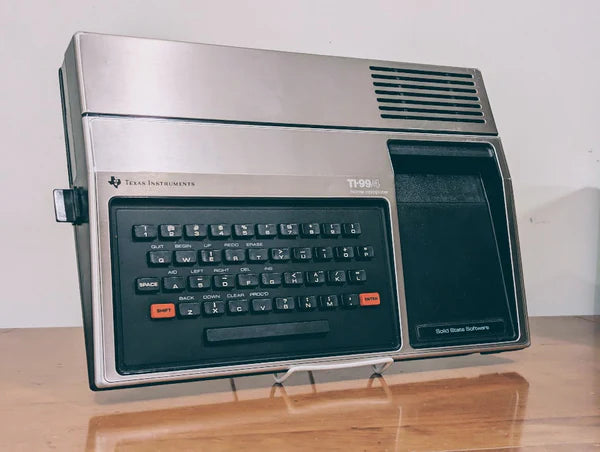
The TI-99/4, released in late 1979 by Texas Instruments for a premium $1,150, was a landmark machine as the world's first 16-bit personal computer, powered by an ambitious advanced microprocessor. Despite its technical "under-the-hood" superiority, the system was famously hindered by a series of restrictive design choices, most notably a cramped, rubbery "chiclet-style" keyboard that was widely disliked by typists and a lack of lowercase lettering. Unlike its more successful successor, the 4A, the original model relied on a specialized Zenith 13-inch color monitor bundled with the unit because it lacked the internal hardware to connect to standard home televisions. Its software library was largely confined to proprietary plastic cartridges because Texas Instruments initially refused to share technical specifications with outside developers, a move that severely limited its library and caused it to struggle against the more approachable Apple II and TRS-80.
Acquired from: eBay.com
✅ Texas Instruments TI-99/4 Peripheral Expansion Box PHP1200 (Original TI-99/4 Variant)
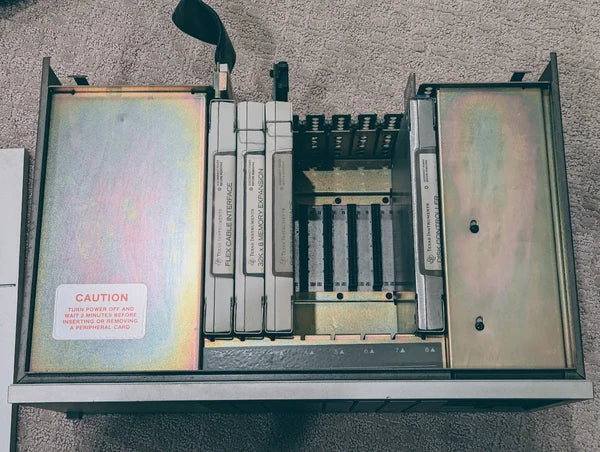
The Texas Instruments PHP1200 Peripheral Expansion Box (PEB), released in 1982 for approximately $250 (unpopulated), was a massive, silver-and-black expansion chassis that transformed the sleek TI-99/4 and TI-99/4A home computers into fully featured desktop workstation setups. Prior to its arrival, expanding a TI computer required daisy-chaining individual side-car modules along the right side of the console in a clumsy "train" that took up feet of desk space and suffered from frequent connection drops. The heavy PHP1200 solved this by consolidating power and expandability into a single heavy-duty unit containing its own internal power supply, cooling fan, a full-sized 5.25-inch floppy disk drive bay, and an eight-slot motherboard. Using a thick ribbon cable that plugged into the console's expansion port, users could insert heavy-gauge circuit cards directly into the box—adding crucial upgrades like 32 KB of RAM expansion, an RS-232 serial interface, a floppy disk controller, or a P-Code card. Although its fan made a distinct, loud hum and the fully loaded box weighed over 30 pounds, the Peripheral Expansion Box became the essential backbone for power users and hobbyists looking to do serious programming, bulletin-board hosting, or business tasks on the TI platform.
TI-99/4 Acoustic Phone Modem PHP1600
The Texas Instruments PHP1600 Telephone Coupler (Acoustic Phone Modem), released in 1980 for $199.95, was an early dial-up networking peripheral designed to connect the TI-99/4 home computer to remote bulletin board systems (BBS) and online services like CompuServe. Operating at a modest speed of 300 baud (roughly 30 characters per second), the PHP1600 was a heavy, wedge-shaped device featuring two soft rubber cups mounted on its top panel. Rather than plugging directly into a telephone jack—which was still strictly regulated by phone companies at the time—users established a connection by dialing a phone number on a standard telephone handset, waiting for the piercing high-pitched carrier tone, and then physically jamming the telephone’s earpiece and mouthpiece tightly into the modem's rubber cups to send and receive digital data via sound waves. Requiring the optional TI RS-232 Interface card and a terminal software cartridge to function, the acoustic coupler gave early 1980s computer enthusiasts their very first taste of telecommunications and online messaging right from their living room desks.
Donated by: Joseph Rodomista