Test Equipment & Meters (c. 1920-1980)
Test Equipment & Meters (c. 1920-1980)
Multiple
Triplet 3423 Tube Tester
The Triplett 3423, released in the early 1950s, was a professional-grade testing machine used by radio and television repairmen to check the health of vacuum tubes—the glass, lightbulb-like ancestors of modern computer chips. Think of it as a smart, heavy-duty doctor for vintage electronics. It was highly prized because it tested tubes under real-world working conditions by sending a gentle audio signal through them, ensuring an incredibly accurate reading without overloading sensitive parts. Neatly built into a rugged wood and faux-leather carrying case with a built-in scroll chart for quick reference, the tester was designed with a flexible switch system. This allowed technicians to test almost any tube available at the time, ensuring the expensive machine wouldn't become obsolete as newer technology hit the market.
Source: Estate Sale
Bell & Howell Model 34
The Bell & Howell Model 34 was a mid-century electronic testing tool featuring a round, five-inch television-style screen that displayed electrical signals as glowing green lines. Instead of buying it fully assembled, students in electronics correspondence schools bought this machine as a do-it-yourself kit. Building the tool from scratch using loose wires, internal vacuum tubes, and oversized plastic knobs was a core part of their hands-on education. Housed in a tough, military-style grey metal cabinet, the Model 34 was built to survive a student's workshop rather than a high-tech lab. Today, it is a favorite centerpiece for vintage tech collectors who love its retro industrial look and the warm, nostalgic green glow of its screen.
Source: Estate Sale
General Electric Type P-3 Ammeter
The General Electric Type P-3 was a premier line of portable electrical meters used from the early 1900s through the mid-20th century to precisely measure volts, amps, or wattage. Beautifully housed in a polished hardwood box with a leather carrying handle, the P-3 was built to withstand the demands of power plants and laboratories alike. It was considered the absolute gold standard for electrical engineers due to its "laboratory-grade" precision, featuring a large mirror built right into the dial face to help technicians line up their eyes perfectly and avoid reading errors. Each instrument was a true work of early 20th-century craftsmanship, hand-calibrated by an expert and shipped with an official, factory-dated certificate of accuracy pasted right inside the lid.
Source: Estate Sale
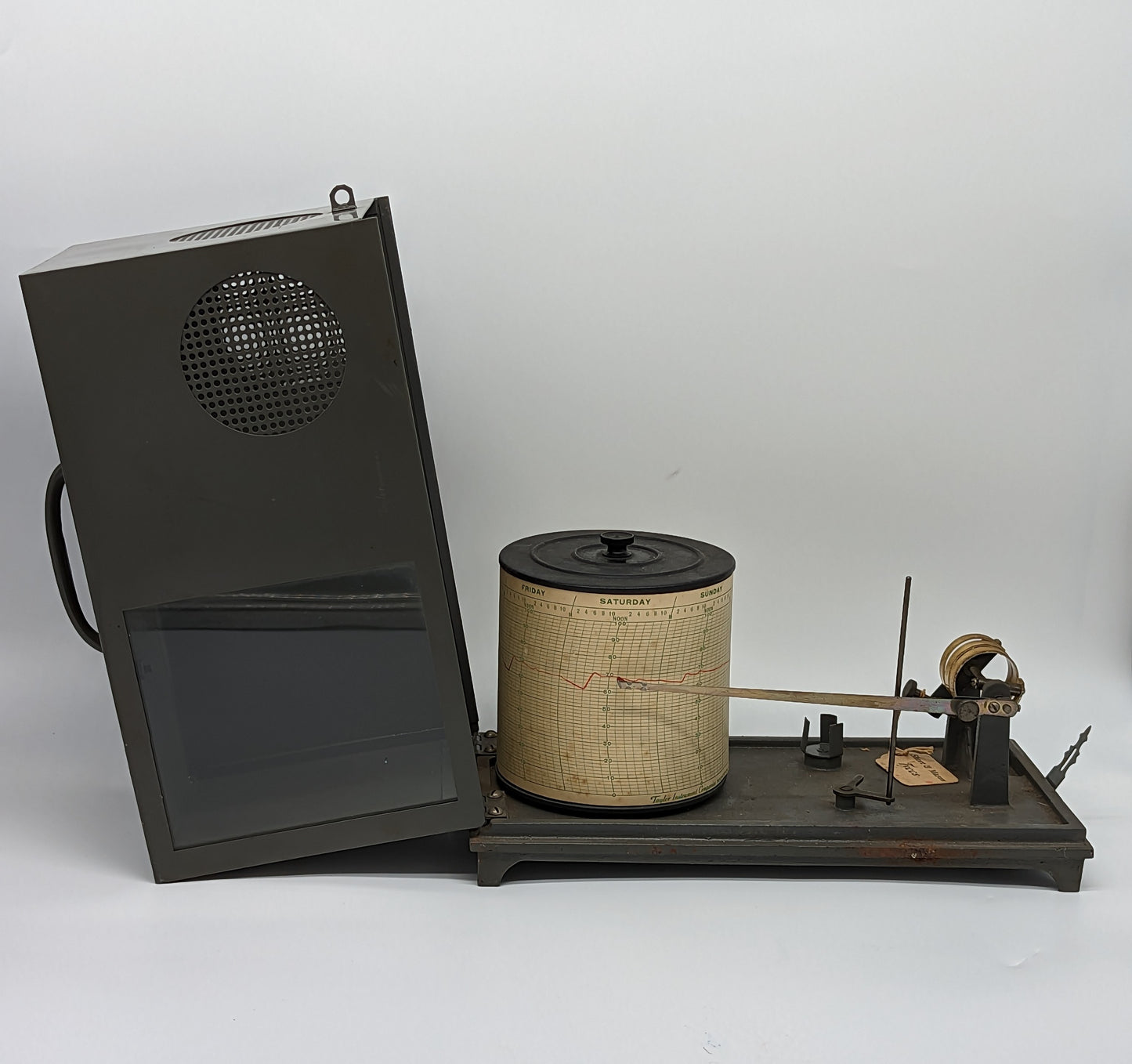
Taylor Tycos Recording Barograoh Model 2315
The Taylor Tycos Model 2315, produced in the 1920s, was an ultra-sensitive weather-tracking machine designed to continuously record changes in air pressure. To detect tiny shifts in the atmosphere, this beautifully crafted instrument used a precise stack of fourteen wafer-thin metal capsules that would expand or contract as the weather changed. This mechanical movement was connected to a delicate ink pen, which drew a continuous, winding line onto a roll of graph paper wrapped around a slowly spinning brass drum. Selling for a hefty $250 in the 1920s (equivalent to about $4,500 today), this premium device was a staple in high-end laboratories, weather stations, and corporate boardrooms, celebrated for its ability to flawlessly track a full seven days of weather trends on a single chart.
Source: Elephant's Trunk Flea Market
Hewlett Packard 5383A Frequency Counter
The Hewlett-Packard 5383A, introduced in 1975, was a high-performance digital counter used by engineers to instantly measure how fast radio frequencies were vibrating. It was a major breakthrough because it brought laboratory-grade accuracy into a compact, portable bench-top box that was affordable for local communications technicians. The machine featured a bright, easy-to-read nine-digit red LED display and could measure high-frequency radio waves with incredible precision. It was built with two different plug-in jacks on the front—one for standard lower frequencies and a protected input for intense radio waves—making it the definitive, no-nonsense tool for tuning and fixing early wireless and radio equipment.
Source: Estate Sale