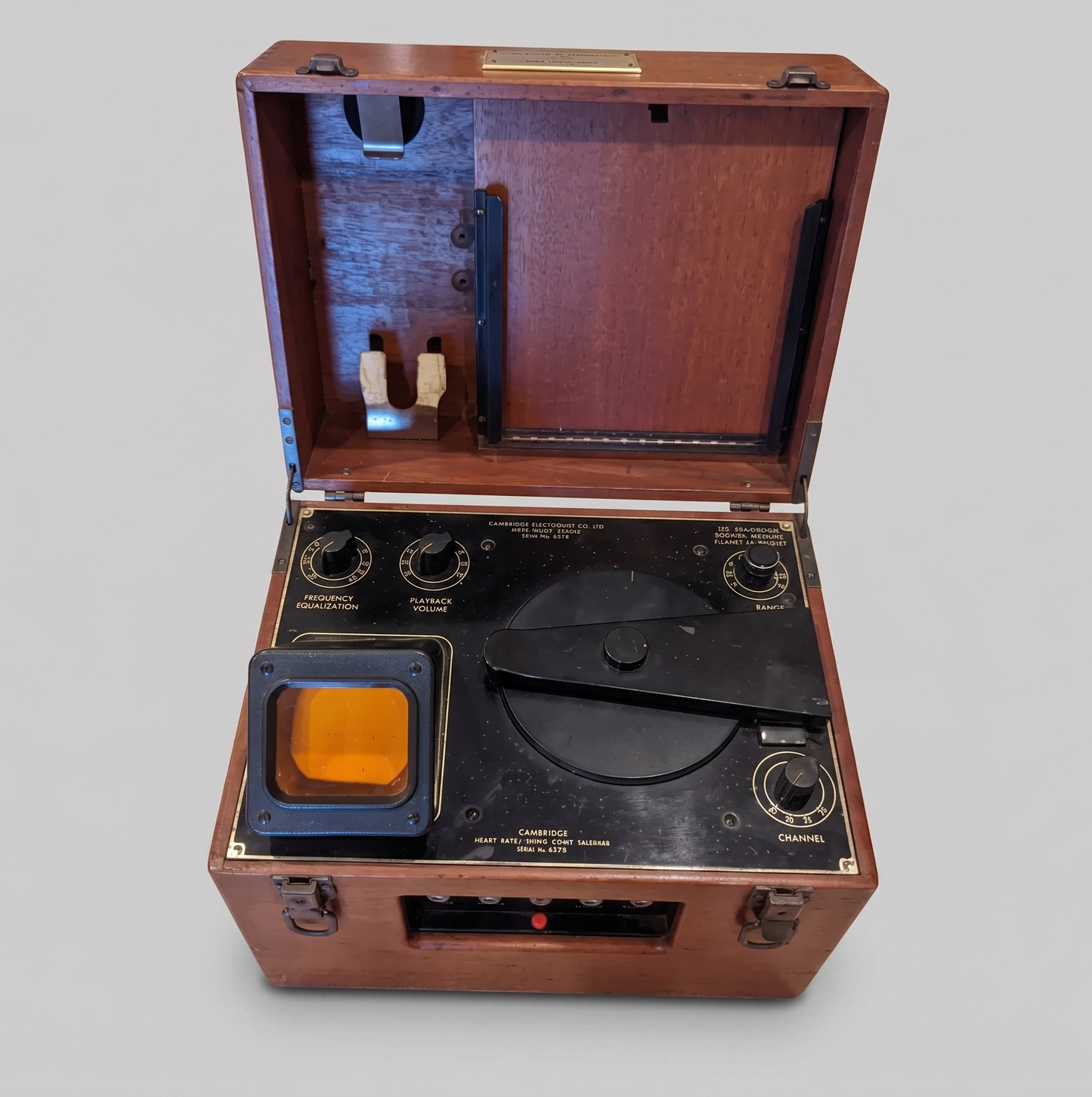
Cambridge Audio-Visual Heart Sound Recorder No. B.M. 21402 (c. 1955)
Cambridge Audio-Visual Heart Sound Recorder No. B.M. 21402 (c. 1955)
Unknown
Cambridge Audio-Visual Heart Sound Recorder No. B.M. 21402
The Cambridge Audio-Visual Heart Sound Recorder (Model B.M. 21402), produced in the mid-20th century, was a sophisticated medical workstation that allowed heart doctors to simultaneously hear and "see" the heartbeat. Housed in a polished wooden cabinet, the machine featured a built-in recording disk that captured deep, low-frequency heart sounds—many of which were too low for the human ear to detect—and translated them into visual wave patterns on a small, glowing television-style screen. Unlike a standard stethoscope, this device used specialized headphones and sound filters so doctors could isolate specific, hidden heart murmurs and save them onto magnetic disks to compare later. It was a massive breakthrough for its time, acting as an early technological bridge that combined traditional listening with electronic visual tracking long before modern digital hospital equipment existed.
Source: Elephants Trunk Flea Market