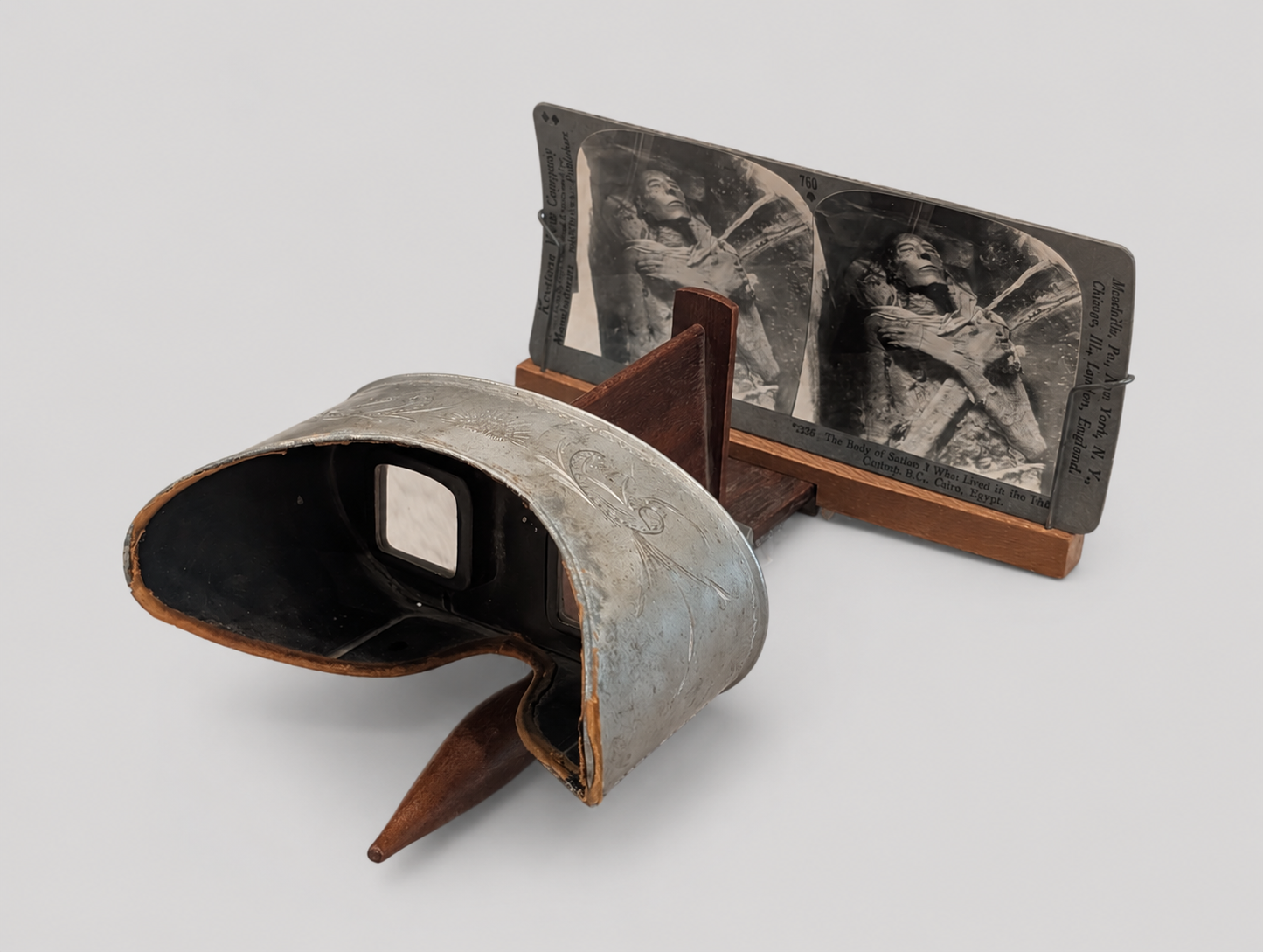
Holmes-Style Stereoscopic Viewer (1861)
Holmes-Style Stereoscopic Viewer (1861)
Oliver Holmes
✅ Holmes-Style Stereoscopic Viewer
The Holmes-Style Stereoscope, invented by American physician and author Oliver Wendell Holmes in 1859, was a wildly popular 19th-century gadget that became the Victorian era's version of virtual reality. Constructed out of lightweight wood and a simple metal wire frame, this handheld viewer worked by tricking the human brain into seeing flat, two-dimensional images as realistic, three-dimensional spaces. A user would place a "stereograph"—a special cardboard card featuring two identical-looking photographs taken from slightly different angles—into a sliding track at the end of a wooden rod. When peering through the stereoscope's hood, which featured a pair of specialized, curved glass lenses, the viewer's eyes would merge the two separate images into a single, seamless picture with an incredible illusion of depth. Because it was incredibly cheap to manufacture and easy to hold with its single wooden handle, Holmes intentionally chose not to patent his design, allowing millions of everyday families to affordable "travel" the world from their living rooms, viewing 3D images of the Egyptian pyramids, distant wars, and exotic landscapes long before the invention of cinema or television.
Acquired from: Elephants Trunk Flea Market