Unless otherwise noted, videos are courtesy of YouTube.
* If you receive an error when viewing a video, please reload page. (known error with Shopify)
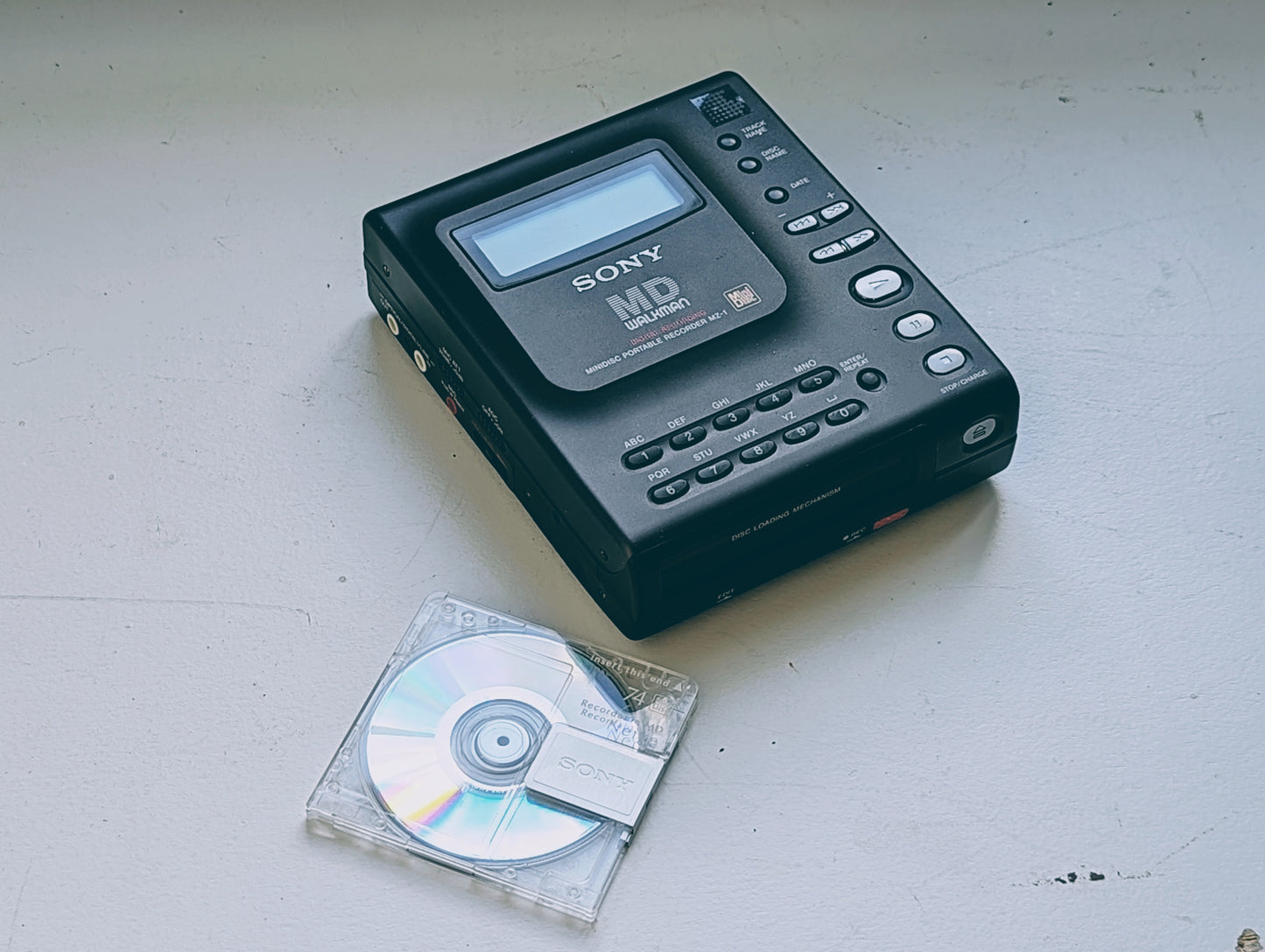
Sony Walkman MZ-1 and Sony MiniDisc (1992)
Sony Walkman MZ-1 and Sony MiniDisc (1992)
Westport Tech Museum
Sony Walkman MZ-1
🥇First Commercially-Released MiniDisc Recorder
The Sony MiniDisc Walkman MZ-1, launched in late 1992, was the "Big Bang" of the MiniDisc era—a chunky, $750 marvel that attempted to bridge the gap between the recordability of cassettes and the digital clarity of CDs. As the world's first MiniDisc recorder, it was famously over-engineered, featuring a high-contrast backlit screen, a 10-key pad for titling tracks, and both optical and analog inputs. While later models became impossibly slim, the MZ-1 was a heavy brick necessitated by its complex slot-loading mechanism and early digital audio chips, which required significant power to compress audio in real-time. It stands as a highly coveted pioneer among audiophiles, celebrated for its robust construction, high-fidelity sound, and its status as a legendary, early standard-bearer for mobile digital recording.
Sony MiniDisc (MD)
The MiniDisc was an erasable disc-based storage format offered by Sony starting in November 1992 in North America (September 1992 in Japan). The MiniDisc combined the technologies of the 3.5" floppy disk and the Compact Disc (CD), which were two technologies developed by Sony. The MiniDisc was extremely successful in Japan, and although it was meant to succeed the cassette tape, it was not able to replace it. By March 2011, Sony had sold 22 million MiniDisc players, although they decided to halt further manufacturing. By March 2013, Sony had stopped production and sold the last of the players.